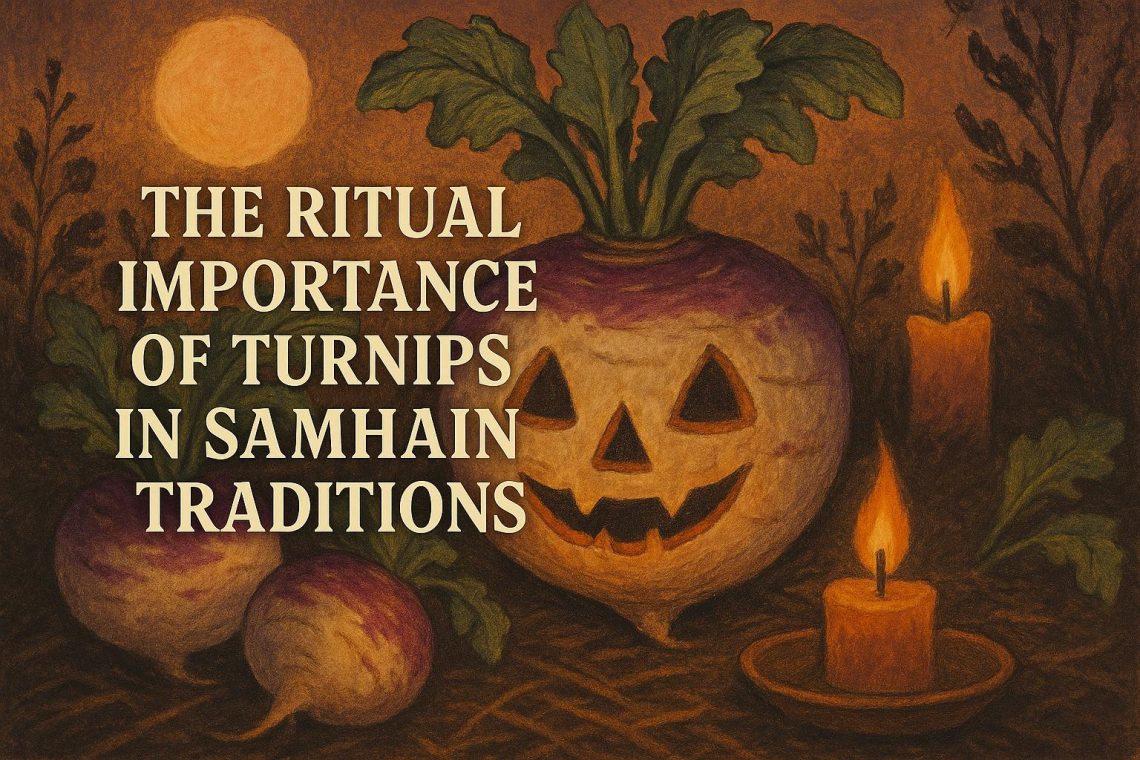
The Historical Significance of Turnips in Samhain Traditions
In various Celtic societies, Samhain marks a critical period, traditionally observed from sunset on October 31st to sunset on November 1st, heralding the end of the harvest season and the onset of winter. Among the many elements that make up Samhain customs, the turnip holds a significant place. While widely overshadowed by the more contemporary pumpkin, the turnip was historically more prevalent and is intricately tied to the ritualistic and symbolic practices of Samhain.
The Role of Turnips in Samhain Celebrations
Turnips were historically used to create lanterns in preparation for Samhain festivities. This practice involved hollowing out the turnip, carving it with faces, and inserting a candle to produce lanterns. The primary purpose of these turnip lanterns was to ward off malevolent spirits. During Samhain, the veil between the physical world and the spiritual realm is believed to be at its thinnest, and these lanterns served as protective measures against any wandering beings.
Traditionally, these carved turnips were a manifestation of the beliefs held by ancient Celts regarding the spirit world. They were seen not only as protection but also as a way to guide relatives who had passed on to the other side, ensuring they safely reached their destinations. In the legends of the time, it was believed that spirits roamed the earth during Samhain, making these lanterns a necessary element to both protect and guide.
The Transition from Turnips to Pumpkins
The use of turnips for carving continued when Irish immigrants brought the tradition to America. However, they found the native pumpkin, which was larger and easier to carve, better suited for the practice. This adaptation marked the evolution from turnip lanterns to pumpkins, giving rise to the modern “jack-o’-lantern” associated with Halloween today. Learn more about the history of Jack-o’-lanterns.
The shift from turnips to pumpkins was not merely practical but also cultural. Pumpkins, with their bright and inviting appearance, came to symbolize the festive nature that modern Halloween embodies. This change facilitated the popularization of the carving tradition, leading to widespread acceptance and incorporation into what we now call Halloween. The transition was a blending of old and new world traditions, creating a festival that retained its historical roots while adapting to new cultural environments.
Symbolic Importance of Turnips
The choice of turnips is not arbitrary. In Celtic symbolism, turnips are seen as representations of both life and death, capturing the essence of Samhain as a time of transition. Their growth in the earth embodies life, while the hollowness from carving signifies death, blending the two in a symbolic gesture aligned with the core elements of Samhain.
This duality is a reflection of the larger beliefs held during Samhain, where the cyclical nature of life was celebrated. The carving of the turnip, therefore, was more than a simple activity; it was a representation of the balance between two states of existence, both honoring ancestors and preparing for the colder months that signified the end of growth and the onset of dormancy.
Turnips in Modern Samhain Observances
While pumpkins largely dominate today’s Halloween traditions, turnips are experiencing a revival in certain areas as communities strive to reconnect with authentic practices of the past. Reintroducing turnips into celebrations can provide a deeper understanding of the ritual’s roots and enrich the cultural experience. To explore more about how turnips are being reintroduced, visit Celtic Festivals.
For modern observers, using turnips instead of pumpkins allows for a return to a more traditional form of celebration. This revival is not limited to smaller communities but is becoming part of a broader movement interested in exploring and maintaining cultural heritage. Incorporating turnips back into Samhain celebrations encourages storytelling, education, and appreciation of cultural history, reflecting a desire to preserve the uniqueness of the Celtic heritage in a world where globalization often leads to cultural homogenization.
In conclusion, while pumpkins may have gained prominence in contemporary Halloween celebrations, turnips continue to hold a vital place in understanding the historical and cultural practices of Samhain. Their legacy persists as a testament to the belief systems and customs of the ancient Celts, offering modern society a chance to reflect on and appreciate the depth of traditional festivities.
The significance of this tradition lies not merely in the act of carving but in the understanding and honoring of the past. Celebrating with turnips is an invitation to engage with history, to understand the layers of cultural evolution, and to appreciate the ways in which they connect our present to the deep-seated traditions of our ancestors. By doing so, we find ourselves not only participating in a festival but also contributing to the cultural tapestry that continues to evolve over time.
The revival and interest in incorporating traditional elements like turnips into modern practices highlight an ongoing dialogue between past and present. This dialogue enriches our contemporary understanding of cultural festivities, inviting people to explore the profound meanings behind the symbols we often take for granted. In the case of Samhain, and its transition into what many now know as Halloween, turnips serve as a key to unlocking not just seasonal celebration, but a deeper appreciation of the interconnectedness of life and death, light and dark, new and old.