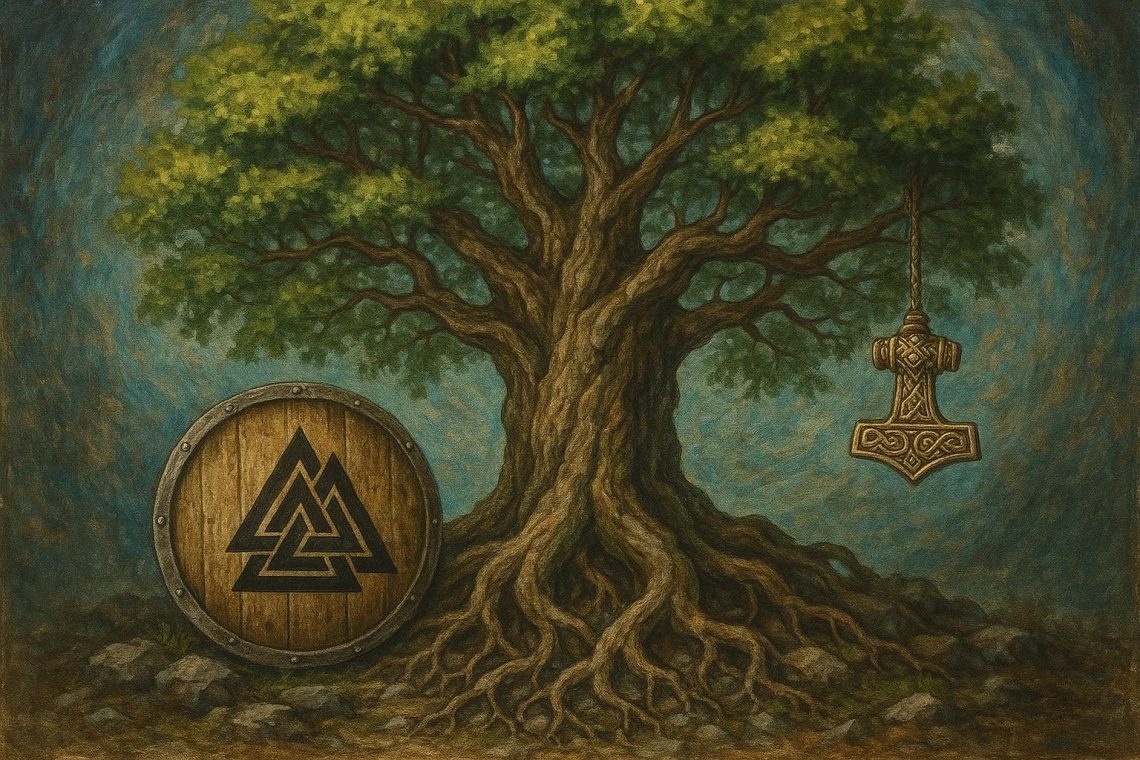
The Significance of Ash Trees in Norse Mythology
In Norse mythology, the ash tree holds a place of great importance and reverence. The ash tree’s connection to Yggdrasil, the sacred world tree, underscores its deep roots in ancient Norse beliefs.
Yggdrasil: The World Tree
Yggdrasil is often depicted as a massive ash tree, and it forms the core structure of Norse cosmology, interconnecting all nine realms. This mighty tree is said to support the universe with its branches stretching across the heavens, while its roots delve deep into various worlds. This depiction is not merely imaginative but symbolizes a profound concept in Norse cosmology, where the ash tree is a pivotal link between different planes of existence.
The tree’s profound presence illustrates the strength and resilience it embodies within the mythological framework. Its towering stature stands as a testament to the endurance and robustness that the Norse attributed to their world tree.
The Nine Realms
Yggdrasil serves as the binding element among the nine realms of existence, providing a structured cosmos where each realm contributes to the universal balance. These realms include significant domains such as Asgard, the dwelling place of the gods, Midgard, the world of humans, and Jotunheim, home to the giants. Additional realms like Vanaheim, Alfheim, and Helheim each play their roles in the overarching cosmological narrative.
Each realm is understood as a crucial component in the mythological cosmography, and Yggdrasil’s link reinforces the ash tree’s foundational status as a universal anchor. This connection provided the ancient Norse people with a structured understanding of their universe, enriched with symbolic meaning and existential philosophy.
Symbolism and Attributes
In Norse culture, beyond its structural significance in cosmological imagery, the ash tree represents broader symbolic concepts. It is emblematic of strength, resilience, protection, and interconnection—themes prevalent within the rich tapestry of Norse mythical narratives. This symbolism can be seen reflected in their stories, where characters draw upon these attributes embodied by the ash tree to guide their actions and fates.
The Creation of Humans
According to Norse mythology, the story of human creation is directly tied to the ash tree. The first man, Ask, was formed from an ash tree, while the first woman, Embla, came from an elm tree. This creation myth not only underscores a critical cultural narrative about human origins but also reinforces the ash tree’s intrinsic association with life and existence itself.
Ask and Embla, as progenitors of humankind, symbolize more than the emergence of people. They illustrate the interconnectedness of all life forms and their reliance upon the natural world—a world represented and sustained by the strength of the ash tree, Yggdrasil. The narrative of human creation from trees continues to underscore a fundamental belief in the shared heritage between nature and humankind.
Cultural Practices and Beliefs
The reverence for the ash tree in Norse mythology echoes throughout the cultural practices and spiritual beliefs of the Scandinavian peoples. While concrete evidence of specific rituals centered around the ash tree is limited, the mythology itself suggests a pervasive respect for trees perceived to have divine connections.
Trees like the ash, revered in the context of Yggdrasil, likely influenced attitudes towards the environment, promoting a worldview where the natural and the divine were inextricably linked. This symbiotic relationship between people and nature is a hallmark of many ancient belief systems, where reverence and respect form the bases of cultural practices.
The role of the ash tree, not only as a cosmological linchpin but also as a mystical, almost sacred entity, suggests it could have been an object of reverence in various ritualistic and spiritual activities. Whether through silent veneration or through more structured rites, the presence of the ash tree in myth points toward its potential involvement in ancient practices focused on harmonizing with nature.
Modern Interpretations
Today, the compelling lore of the ash tree continues to inspire storytellers, authors, and various cultural expressions. Modern depictions of Norse mythology often incorporate elements from these ancient narratives, where the idea of the world tree finds expression in contemporary storytelling. The enduring image of Yggdrasil represents a timeless connection across cultures, illustrating the tree’s lasting symbolic power.
The resurgence of interest in Norse mythology can also be seen in literature, music, and film, where elements such as the world tree are woven into new narratives. These narratives find resonance in an era searching for meaning through ancient wisdom. From philosophical discussions to artistic representations, the enduring legacy of the ash tree as Yggdrasil continues to captivate modern imaginations.
For those seeking a deeper understanding of how Norse mythology, particularly the symbolism of the ash tree, impacts modern culture, resources detailing ancient texts, archaeological influences, and academic analyses are invaluable. These sources provide deeper insights into the mythological framework that endures as a significant part of cultural heritage worldwide.
In summary, as a central figure in Norse mythology, the ash tree embodies complex ideas about the universe, existence, and vital connections within nature. Its enduring presence in mythological narratives speaks to its deep-rooted significance in the belief systems of the ancients, continuing to inform and inspire even today. The ash tree, through its ancient stories, remains a timeless symbol of interconnected life, strength, and resilience, uniting the mythical with the material, the past with the present.